REVIEW · SPLIT
Split and Trogir Half Day Tour from Split (with port pickup)
Book on Viator →Operated by Croatian Trails · Bookable on Viator
Split and Trogir in one go can be magic. This half-day tour strings together Diocletian’s palace in Split and UNESCO-listed Trogir, with live commentary and an air-conditioned coach that keeps the day from feeling like a sprint. I like how the plan is structured but still leaves time to wander, and I’ve seen guides like Tina and Sandra turn quick stops into stories you can actually picture.
My favorite part is the simple logistics: central pickup and drop-off that work well on a cruise day. The one thing to watch is pacing—this is a city-walk tour with multiple short stops, so plan for some uneven streets and a moderate amount of walking.
In This Review
- Key things that make this tour worth your time
- A half-day that actually works: Split and Trogir without the scramble
- Price and what you’re really paying for
- Pickup, timing, and cruise reality (the part that matters)
- The coach ride: comfort, but also a moving “pre-class”
- Stop 1: Palazzo di Diocleziano in Split (20 minutes)
- Trogir by coach: the quick ride that sets the tone (and saves your feet)
- Stop 2: Historic city of Trogir (about 1 hour)
- Cathedral of Saint Domnius: a short stop with a big structure story (20 minutes)
- Kula Karmelengo: castle vibes and performance-season history (20 minutes)
- Prokurative in Split: a Venetian-style square feeling (15 minutes)
- Saint Lawrence’s Cathedral: a Romanesque-Gothic time capsule (15 minutes)
- How the guide shapes the experience (Tina, Sandra, Hrvoje, Roko, Josipa)
- Walking, pace, and weather: what to plan for
- Who should book this tour (and who might skip it)
- Final verdict: should you book Split and Trogir from Split with port pickup?
- FAQ
- How long is the Split and Trogir half-day tour?
- What’s included in the tour price?
- Are entrance fees included for all stops?
- Where do cruise passengers meet for pickup?
- Where does the tour end?
- Is there any walking involved?
- What language is the tour offered in?
- Is there an air-conditioned vehicle?
- Does the tour run in bad weather?
- What do I need to provide if I’m on a cruise?
Key things that make this tour worth your time
- Port pickup + A/C coach: you save energy on transport and heat.
- UNESCO coverage without a full day: Roman Split, then Trogir’s layered architecture.
- A guide who talks like a local: names like Tina, Sandra, Hrvoje, and Roko show up often in standout experiences.
- Built-in photo windows: you’re not just riding by; you stop at the big visual moments.
- Entry fees are selective: several stops are free to enter, while others are not included.
- Small group cap (50): it tends to feel more personal than the mega-bus vibe.
A half-day that actually works: Split and Trogir without the scramble
If your time in Croatia is limited—especially a cruise port day—this kind of tour is pure practicality. You get enough structure to see the key sights in Split and Trogir, and you also get guided context so you understand what you’re looking at. Without that, you’d just see stone and assume it has a story. With the tour, the stones make sense.
The total time is about 4 hours. That’s short enough to keep the day comfortable, but long enough to cover multiple landmarks instead of rushing through one street and calling it a win.
You can also read our reviews of more tours and experiences in Split.

Price and what you’re really paying for
At $78.61 per person for a half-day, you’re not just buying a ticket to “look at buildings.” You’re paying for:
- Live on-board commentary and a professional guide who helps you connect the dots
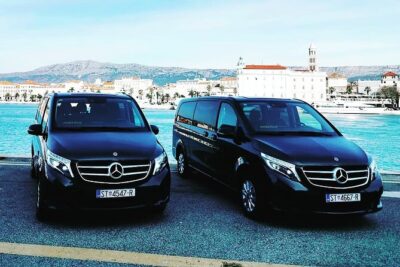
- Air-conditioned vehicle (huge in summer)
- Port pickup for cruise passengers
- Guided stops at several important locations in both towns
Entry fees are not included for some stops, so the final cost depends on what you choose to pay for. Still, the value is strongest if you care about efficiency: you’re using a coach to cover the distance between Split and Trogir and getting interpretation at each stop.
If you’re the kind of traveler who enjoys planning a self-guided route, you might be able to do it cheaper on your own. But if you want a smooth timeline and someone handling the flow, this price feels reasonable for what’s packed into a short window.
Pickup, timing, and cruise reality (the part that matters)
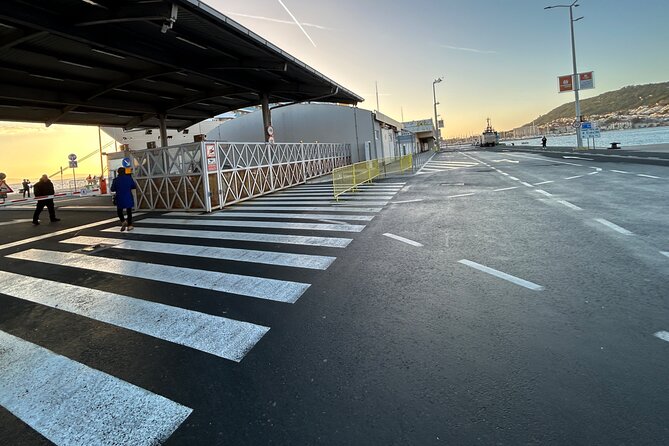
This tour is built for cruise days, and that means the schedule hinges on ship timing. You meet at the New Split Berth for cruise ships (Obala kneza Domagoja 16, Split). The tour ends in the Split city center near Split Riva, and there’s no formal drop-off—expect about a 20-minute walk back to the ship’s terminal area.
If you’re not on a cruise ship, exact pickup details are sent one week prior via Viator messaging.
One practical tip that saves stress: follow the meeting instructions precisely. The guide carries a sign reading Croatian Trails and stands at the entrance to the ship’s terminal near the hop-on/hop-off red buses. Don’t wing it by asking random directions—people can point you to the wrong gate.
The coach ride: comfort, but also a moving “pre-class”
You’ll travel by an air-conditioned coach, and you’ll get live commentary while you ride. That matters because the drive time isn’t wasted time—you hear the story of what you’re about to see.
This also helps if the weather is hot (and it often is). Even if you end up doing some walking, arriving at each stop feeling less fried makes the whole day more enjoyable.
The tour runs in all weather. That’s not just a legal phrase—it’s useful planning information. When rain hits (and it does sometimes), wear something you can handle for a short walk and keep your expectation realistic: you’re still seeing the main sites, but the photos may be wetter and your shoes matter.
Stop 1: Palazzo di Diocleziano in Split (20 minutes)

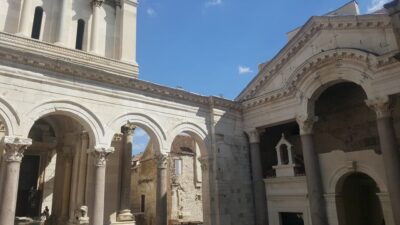
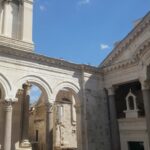
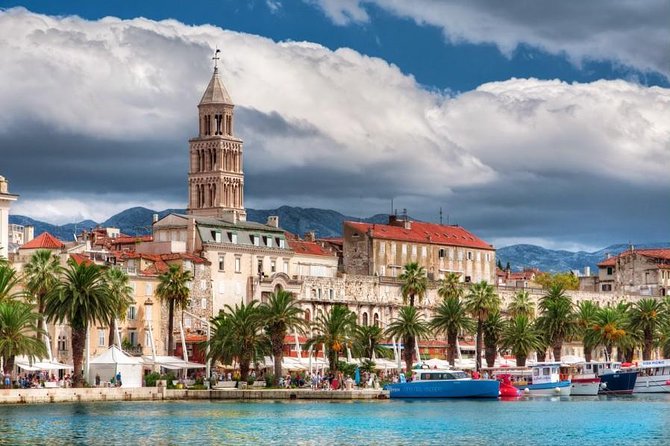
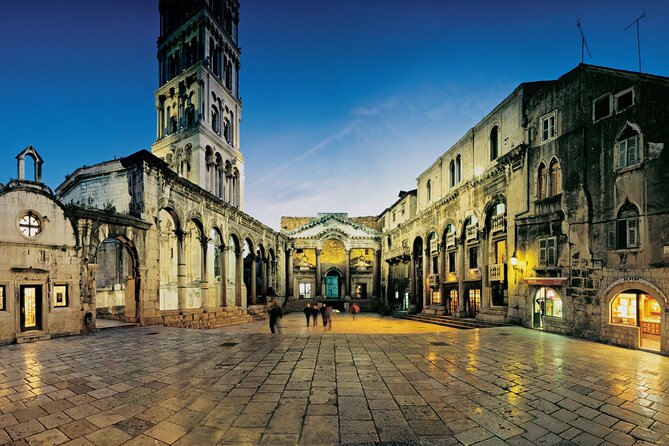
Diocletian’s palace is the backbone of Split. About half of the old town and city center grew out of this ancient palace built around the turn of the 4th century AD by the Roman emperor Diocletian.
In 20 minutes, you’re not doing a slow museum visit. You’re getting orientation: where you are in the original Roman layout, how the palace shapes the streets today, and what to notice as you walk through. If you’ve ever been inside an ancient complex and felt lost, the guiding here helps you avoid that.
Admission here is not included, so if you want to go in beyond the immediate areas, budget for that extra entry fee.
Trogir by coach: the quick ride that sets the tone (and saves your feet)
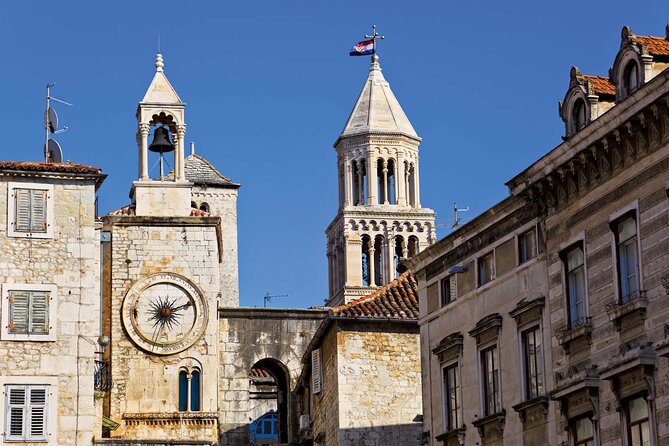
After Split, you’ll head to Trogir with a short ride along the coast. This transition is more than transport. It’s a mental shift from Split’s palace-centered layout to Trogir’s long architectural timeline.
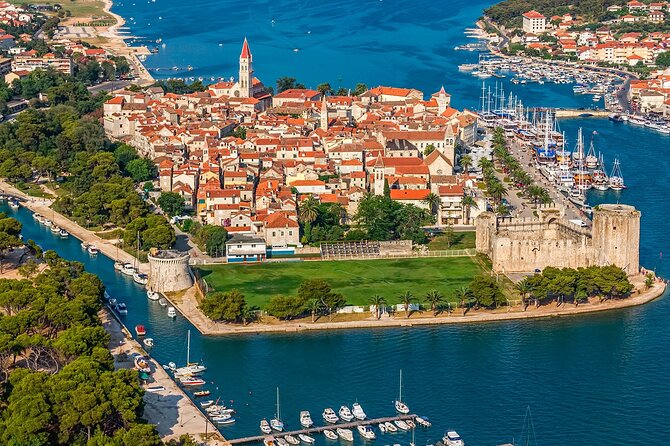
Trogir is UNESCO-listed, and it’s one of the best places in the area for seeing how different eras layered on top of each other.
You get about 1 hour in Trogir, which is a good amount for walking, taking photos, and still having time to actually look at details.
Stop 2: Historic city of Trogir (about 1 hour)
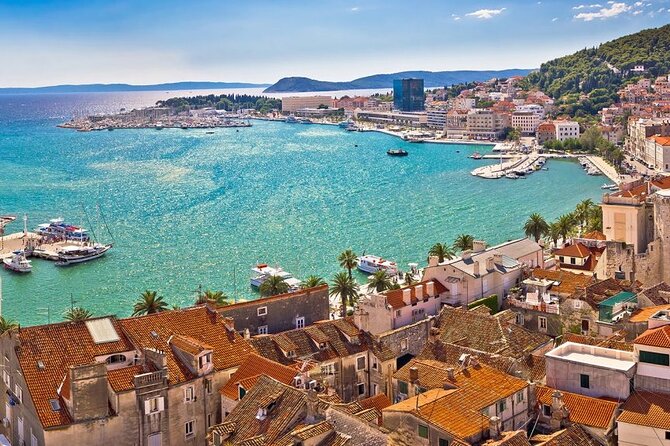
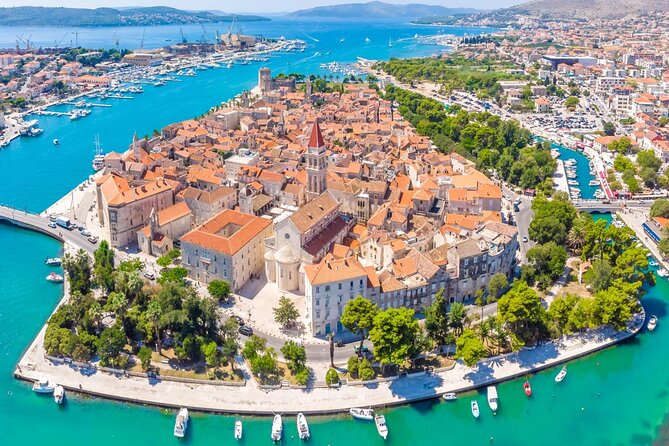
Trogir was founded by Greek colonists in the 3rd century BC. The result is a city with roughly 2300 years of continuous urban tradition.
What makes the one-hour window work is the way the guide frames what you see. You’re not just walking around. You’re getting a quick map in your head: Romanesque churches, then Renaissance and Baroque buildings that reflect the Venetian period.
This is also one of those places where small details matter. Doorways, church facades, and street alignments carry the “why” of the city’s evolution.
Entry for this stop is listed as free, so your money here goes to your own choices—snacks, coffee, and whatever you want to explore around the guided route.
Cathedral of Saint Domnius: a short stop with a big structure story (20 minutes)
The Cathedral of Saint Domnius is a mix of different elements: it started as an Imperial Roman mausoleum, and later became a church complex. The dedication is split in a way that sounds confusing until someone explains it: the church is dedicated to the Virgin Mary, and the bell tower is dedicated to Saint Domnius.
You’ll get about 20 minutes here. That’s enough for a focused look and a quick appreciation of why the complex feels “assembled” across time.
Admission is not included at this stop, so decide in advance if you want to pay to go further into the site.
Kula Karmelengo: castle vibes and performance-season history (20 minutes)
Kula Karmelengo is the castle element in the tour plan, built mid-15th century by Marin Radoj as part of an expansion. It connects to earlier structures on the site from the late 14th century.
You’ll also hear the practical note that it’s used for performances during summer months. Even if you’re not there during a show, that detail gives the place a living purpose instead of treating it as a static backdrop.
Admission here is not included.
Prokurative in Split: a Venetian-style square feeling (15 minutes)
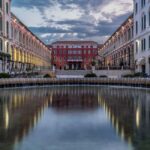
Back in Split, you’ll pause at Prokurative. This 19th-century complex was built under General Marmont and kicked off by Split’s mayor Antonio Bajamonti.
The design is strongly inspired by Italian architecture of the time and closely resembles St. Mark’s Square in Venice. One interesting point is that the architect was from Venice and wanted the structure to remind him of home.
You only get about 15 minutes, so think of this as a quick “here’s what it resembles” moment rather than a deep architectural study. It’s short, but the description helps you notice the form instead of just recognizing it as pretty stone.
Admission is listed as free.
Saint Lawrence’s Cathedral: a Romanesque-Gothic time capsule (15 minutes)
Saint Lawrence’s Cathedral is a triple-naved basilica constructed in Romanesque-Gothic style in Trogir. Since construction lasted across centuries, it shows styles that followed one another in Dalmatia.
You’ll get about 15 minutes, which is just long enough to take in the scale and understand why the building looks like it changed hands over time—because it did.
Admission is listed as free.
How the guide shapes the experience (Tina, Sandra, Hrvoje, Roko, Josipa)
The itinerary is solid, but the guide is where the day turns into a story you remember.
In the better versions of this tour, guides like Tina and Sandra keep the commentary human and organized, not just a list of dates. Hrvoje and Roko also show up in standout experiences, with a consistent theme: the best guides connect the places to life in Croatia, not just to an exam answer.
One practical outcome of this is that your free time feels easier. When a guide explains what to look for and what streets are worth your extra steps, you don’t wander randomly—you wander smarter.
Walking, pace, and weather: what to plan for
This tour is built around multiple short stops rather than long museum sessions. That means you do a fair bit of walking between locations, on city streets that can be uneven.
Based on the tour’s “moderate physical fitness” guidance and how the stops are set up, I’d classify it as a Level 2 style day: manageable for many people, but not ideal if you hate walking or your legs hate hills.
Weather-wise, it runs in all conditions. So bring layers and plan footwear you can handle for short stretches in rain or slick pavement.
Who should book this tour (and who might skip it)
Book it if:
- You want Split + Trogir in a single half day and don’t want to DIY the logistics
- You’re doing a cruise port stop and need a guided plan with pickup
- You like short, focused stops with context and time to look around
Skip it if:
- You want long, slow time inside churches and museums
- You hate walking and prefer one main site per trip
- You’re already comfortable doing this on your own and want total control
If you like structure but still want breathing room, this hits a sweet spot.
Final verdict: should you book Split and Trogir from Split with port pickup?
Yes—if you’re on a time crunch, this is the kind of tour that helps you see the big picture without burning the whole day. I especially like it for cruise travelers because the route is timed, the coach handles the distance, and the guide gives you a mental map so your photos and memories make sense later.
Just be ready for city walking, and keep an eye on which stops have entry fees not included. If you can handle that, you’ll leave with two towns worth of “how did they build all this?” energy—without feeling like you raced through them.
FAQ
How long is the Split and Trogir half-day tour?
It’s approximately 4 hours.
What’s included in the tour price?
It includes live commentary on board, a professional guide, port pickup, an air-conditioned vehicle, and all taxes/fees.
Are entrance fees included for all stops?
No. Entrance tickets are not included for Palazzo di Diocleziano, Cathedral of Saint Domnius, and Kula Karmelengo. Other stops listed are free.
Where do cruise passengers meet for pickup?
At the New Split Berth for cruise ships at Obala kneza Domagoja 16, 21000, Split, Croatia.
Where does the tour end?
The tour ends in the Split city center at Split Riva, and drop-off is not included.
Is there any walking involved?
Yes. The tour includes multiple stops with walking between areas, and it requires moderate physical fitness.
What language is the tour offered in?
English.
Is there an air-conditioned vehicle?
Yes, you’ll travel by an air-conditioned coach.
Does the tour run in bad weather?
It operates in all weather conditions, so dress appropriately.
What do I need to provide if I’m on a cruise?
You must provide your ship name, docking time, disembarkation time, and re-boarding time at booking.