REVIEW · SPLIT
Private Electric Rickshaw Tour of Split
Book on Viator →Operated by Riksa Tour Split · Bookable on Viator
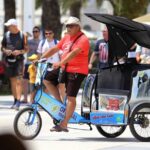
That first hill outside the old town can feel steep. This private electric rickshaw tour helps you see Split’s top sights with less walking. You’ll cruise by the Adriatic waterfront and around Diocletian’s Palace without sweating the route.
I really like how efficient it is for limited time. You get a guided loop that hits major landmarks in short, digestible stops. I also like that the ride is electric and geared for questions as you go, so you’re not just staring at buildings—you’re learning what you’re looking at.
One possible drawback: it’s a “see-and-skim” format. The stops are brief, so if you want long museum time or slow wandering, you may want to add extra independent time after the rickshaw.
In This Review
- Key things to know before you book
- The big idea: see more of Split without playing walking roulette
- Meeting point and how the ride feels
- Stop 1: Riva Harbor, where Split sets the tone
- Stop 2: Prokurative and the Venetian connection
- Stop 3: Croatian National Theater facade in a short window
- Stop 4–5: Diocletian’s Palace gates, the highlights you came for
- Stop 6: Gregory of Nin’s statue and the old tradition
- Stop 7–8: Silver Gate and the substructures below the surface
- Stop 9: Bronze Gates and the myth-inspired reliefs
- Stop 10: Matejuška fishing harbor, seafood culture in plain sight
- Stop 11: Sustipan views and fortification remains
- Park Zvončac and the Museum stop: short pauses, read what matters
- Stop 12: Meštrović Gallery in Marjan Forest Park
- Stops 13–16: Obojena Svjetlost Beach, Marjan trails, and the swim-option vibe
- The free drink detail at Va Bene café
- Stop: Poljud Stadium as a “today Split” stop
- How long should you choose: 30 minutes or 2.5 hours?
- Who this tour suits best
- Quick practical notes that can save you stress
- Should you book the Private Electric Rickshaw Tour of Split?
- FAQ
- What’s the duration of the Private Electric Rickshaw Tour of Split?
- Where does the tour start and end?
- Is this tour private?
- How many people can ride in one rickshaw?
- What admissions are included during the tour?
- Is there a food or drink included?
Key things to know before you book

- Private rickshaw, just your group with a driver-guide you can ask questions to
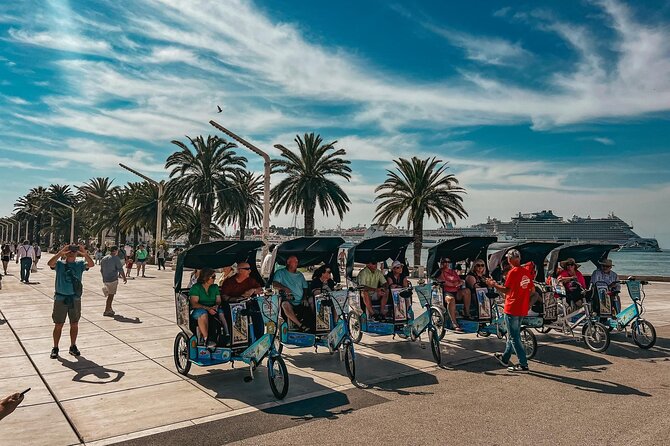
- Electric, eco-friendly transport that saves your legs on Split’s hilly old town streets
- Built for flexibility with tour lengths from 30 minutes up to 2.5 hours, so you can choose your pace
- Diocletian’s Palace focus, including gates and palace substructures, plus the big Gregory of Nin statue
- Marjan Forest Park included with a longer natural break from the city core
- Optional longer-route perks, with a free drink at Va Bene café on the Bene Beach segment of the largest tour
The big idea: see more of Split without playing walking roulette
Split is famous for gorgeous architecture, sea views, and centuries of history. The catch is simple: the city core is compact, but it can still feel like a lot of uphill, backtracking, and hurry-up walking—especially in heat or when cruise crowds hit.
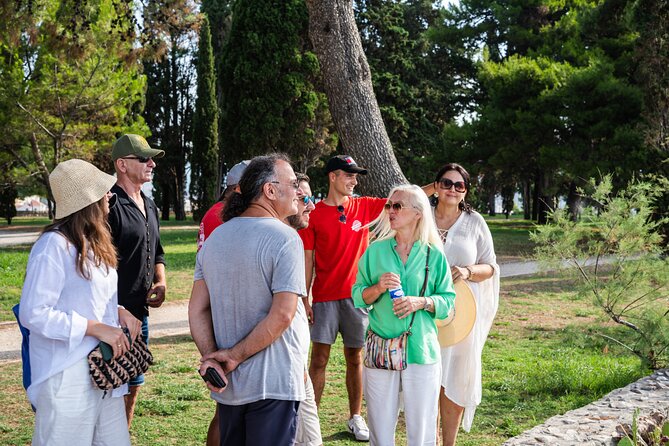
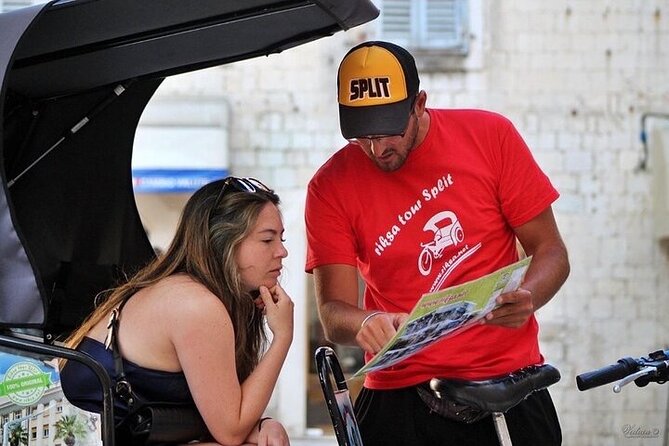
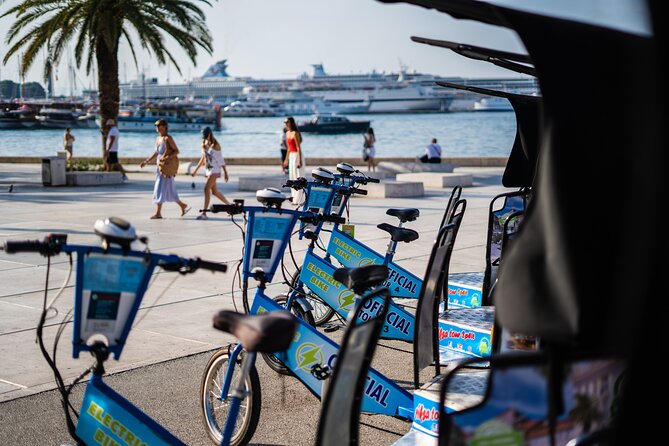
This private electric rickshaw tour solves that. You sit back while your driver-guide takes you around the city center and the Marjan area, and you stop long enough to get photos and context. Since it’s a private setup (only your group), you’re not trying to keep pace with strangers or losing time because the schedule is built for a crowd.
Price-wise, $46.10 per person can sound high until you think about what you get: private transportation for a small group, a guided route through multiple major sights, and key admissions for Marjan Park and Bene Beach (on the included segments). If you’re short on time—like a same-day cruise port visit—this can be a smart “make the hours count” choice.
You can also read our reviews of more private tours in Split

Meeting point and how the ride feels
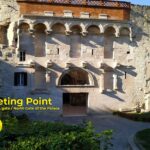
You’ll start at the Model of Palace on Obala Lazareta 1 (Split). The tour ends back at the same meeting point, which is helpful if you’re planning a lunch reservation or catching a later ferry or bus.
The rickshaw capacity is limited: a maximum of 2 adults and 1 child (up to age 10) per rickshaw. That matters if you’re traveling as a family or with a small group. If you have more people than that, you’ll need to check how your party will be handled, since the cap per rickshaw is explicit.
Also, the experience notes good weather is required. If the weather turns, you’ll either be offered another date or a full refund. In other words, don’t plan your entire day around this single slot if you’re arriving on a shaky weather forecast.
Stop 1: Riva Harbor, where Split sets the tone
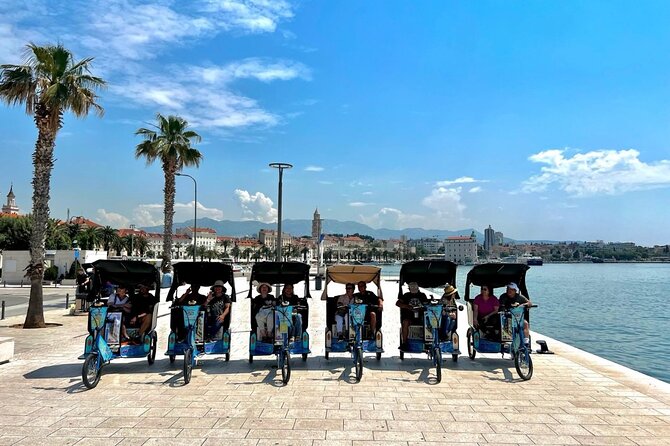
The ride begins at the Riva Harbor, the waterfront promenade where locals and visitors gather. Expect a strong “Split postcard” feel: sea views, historical buildings in the background, and plenty of places to pause and look.
Riva works well as your first stop because it gives you context fast. Your eyes start to understand the city’s shape and relationship to the Adriatic. Even if you spend just a few minutes here, you’ll feel oriented.
Small consideration: since the Riva is a popular meeting point, it can be busy. If you want photos without crowds, you’ll likely get your best shot during a quick gap when your timing aligns.
Stop 2: Prokurative and the Venetian connection
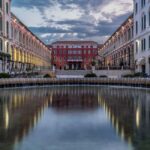
Next up is Prokurative, a grand square with wide space framed by elegant colonnades, arches, and ornate façades.
The name comes from Latin, linked to representation, and the design reflects Split’s historical ties with Venice through its Venetian-style architecture. It’s one of those places where the detail rewards even a short stop.
Drawback to note: because your time here is brief, you’ll want to glance up as you walk. If you wait to read every plaque and then realize you’ve run out of time, you’ll miss some of the visual impact.
Stop 3: Croatian National Theater facade in a short window
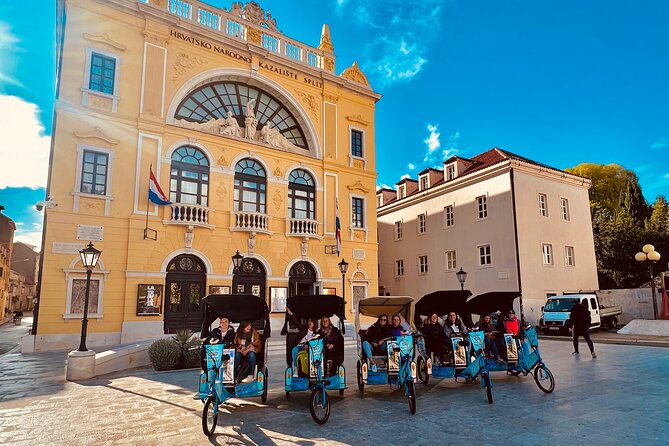
You’ll pass or stop by the Croatian National Theater (HNK), founded in 1893. The main thing you’ll notice is the neoclassical façade with striking styling.
HNK is a reminder that Split isn’t just stone streets and sea views—it has a continuing arts scene. Even if you’re not seeing a performance, the exterior helps you picture the city’s cultural identity.
Practical tip: if you’re taking photos, try to step to the side so you get both the façade and the street alignment. With quick stops, positioning matters.



Stop 4–5: Diocletian’s Palace gates, the highlights you came for
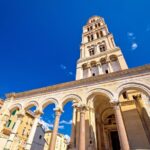
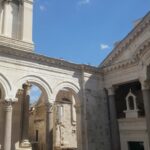
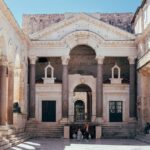
Now the tour really clicks into “what you came for” territory: Diocletian’s Palace. Built in 304, it’s a core anchor for Split and a major reason the city looks the way it does.
You’ll tour around the palace and see the famous entrances:
- Golden Gate: the iconic north-side entrance, originally decorated with golden elements (the name is tied to those gilded features).
- Silver (Eastern) Gate: the eastern-side entrance, once known for silver-colored decorations.
- Bronze Gates: ornate gates on the southern side with detailed reliefs.
Even in a short time, these gates give you a clear sense of the palace’s layout and power. They also help you connect what you see with what you’re learning from your guide—why these entrances mattered, and how the architecture signals status and function.
One consideration: gate viewing is visual and fast. If you’re hoping for a slow, deep architectural study, this isn’t that. It’s built for breadth and getting the story straight.
Stop 6: Gregory of Nin’s statue and the old tradition
Outside the northern gate you’ll find the Grgur Ninski statue—a large bronze figure associated with a 10th-century Croatian bishop. The statue is about 7 meters high and was created in 1929 by sculptor Ivan Meštrović.
There’s a well-known local tradition: rubbing the statue’s big toe is said to bring good luck. It’s also an easy photo spot, and your driver-guide can often point you to the best angle.
Tip for your photos: aim for a wider shot that includes the gate area behind it, not just the statue close-up. It helps your pictures look more like “Split” and less like a random bronze figure.
Stop 7–8: Silver Gate and the substructures below the surface
You’ll also see the Eastern (Silver) Gate and then move into Diocletian Palace substructures, the underground complex that historically served storage and living quarters. There’s even a bronze entrance door noted for this area.
This is one of the smartest parts of the tour for people who like variety. The city above can be bright and crowded. The substructures pull you into the idea that Diocletian’s world wasn’t all monuments—it was also practical infrastructure.
Practical note: you’ll have a short time window here, so don’t plan to memorize every detail. Instead, focus on the big picture: underground purpose, gate placement, and how the palace worked as a whole system.
Stop 9: Bronze Gates and the myth-inspired reliefs
The Bronze Gates are described as ornate entrances featuring intricate reliefs and mythological scenes and figures. As you approach, you’ll see the detailed craftsmanship that signals Roman influence and imperial confidence.
This stop is great if you like “texture tourism”—looking for carved patterns and the way the reliefs catch light. It’s also a good moment to slow your pace for a minute, since the gate details are the kind of thing you’ll miss if you’re rushing to the next stop.
Stop 10: Matejuška fishing harbor, seafood culture in plain sight
Then you’ll head toward Matejuška Fishing Harbor, on the western side of old town. This is where the maritime side of Split shows up: colorful boats, nets, and a fish market atmosphere.
It’s an authentic-feeling stop because it doesn’t feel staged. You’re seeing the working side of the waterfront, with local fishermen bringing in daily catch and selling fresh seafood.
If you’re hungry, this is a tempting area to snack. Just remember your rickshaw schedule is tight, so plan food purchases so you don’t lose time at the next photo stop.
Stop 11: Sustipan views and fortification remains
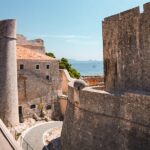
From the harbor, you move toward Sustipan, a rocky promontory with views over the Adriatic and nearby islands. It has a history as a strategic defensive point, and you’ll see ancient stone walls and remains of fortifications.
This stop is a nice counterbalance to the palace and gates. Instead of more buildings, you get big sky views and a more peaceful break from the busiest streets.
Practical consideration: rocky viewpoints can be uneven underfoot. Wear shoes you’re comfortable walking on, even if it’s just a short segment.
Park Zvončac and the Museum stop: short pauses, read what matters
Your route also includes Park Zvončac and a stop for the Museum of Croatian Archaeological Monuments. The key takeaway here is timing and attention. With limited time, you’ll get the best value if you use these as orientation stops—take a look, grab photos, and let your guide highlight what’s worth remembering.
If museums are a big priority for you, you might want to plan a separate visit outside the rickshaw day so you can spend more time reading and exploring.
Stop 12: Meštrović Gallery in Marjan Forest Park
You’ll then head into Marjan Forest Park area and stop at the Meštrović Gallery. This museum is dedicated to works by Ivan Meštrović and is housed in a villa built by Meštrović himself.
Expect a mix of sculptures, drawings, and architectural designs, plus temporary exhibitions. The gallery is also part of the pleasure: the gardens and panoramic views add to the setting, so even a short stop feels like more than a quick museum peek.
One note: because your time at each stop is limited, focus on the pieces your guide points out. That way you don’t end up doing a “checklist tour” of statues with no story.
Stops 13–16: Obojena Svjetlost Beach, Marjan trails, and the swim-option vibe
Marjan Park shows up as more than a scenic background. Your route includes:
- Obojena Svjetlost Beach: named for how colors reflect off the sea, plus soft sand and a lively beach-bar vibe with amenities and water sports.
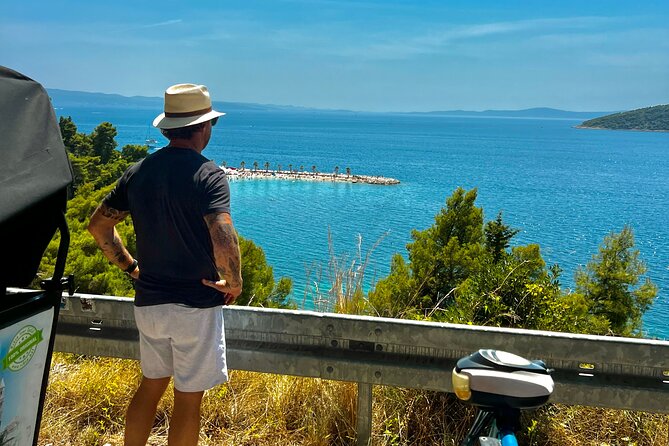
- Marjan Park: this is the long one at about 45 minutes, with St. Nicholas Church mentioned as the iconic landmark perched on the highest peak.
- Kašjuni Beach: at the foot of Marjan, with a mix of pebbles and sandy areas and views down the coast.
- Bene Beach: another beach stop on the western side of Marjan, described as family-friendly with shallow calm water.
Two practical reasons Marjan is worth your time:
- It breaks the city-walk pattern. You get shade, sea air, and natural scenery.
- It makes Split feel like more than old stone and ticket lines.
And yes, you may see people lingering. If you want a quick photo-only stop, that’s fine. If you want a slow few minutes watching the water, this part of the tour is the place to do it.
The free drink detail at Va Bene café
On the largest-duration version of the tour, there’s a free drink included at Va Bene café at Bene Beach. If you’re choosing between short and long options, this is one small perk that can make the longer route feel more satisfying.
Stop: Poljud Stadium as a “today Split” stop
Your route also lists Poljud Stadium. The practical value here is perspective. Seeing it from the tour helps you understand that Split isn’t only ancient architecture. There’s a modern city life layer too.
You likely won’t get a deep stadium tour in this short stop, but it can still help your photos and mental map.
How long should you choose: 30 minutes or 2.5 hours?
You’ll see the tour range listed from 30 minutes up to about 2 hours 30 minutes. That difference changes what you actually get out of the ride.
If you choose the short option, aim to use it as a high-impact loop of core sights: harbor views, palace gates, and the key stops you’ll remember. If you choose the longer run, the Marjan segment becomes the reward. That longer version adds the beaches and a longer park break, including Marjan Park entry and time for the park highlights.
If I’m helping you decide, I’d say pick longer if:
- you want a real change of scenery beyond the old town
- you’d like more time for photos at viewpoints and beaches
- you’re traveling with someone who doesn’t love lots of uphill walking
Pick shorter if:
- you’re pressed for time due to cruise or a bus schedule
- you mainly want the Diocletian’s Palace and city center story
Who this tour suits best
This private electric rickshaw is a good match if you want:
- maximum sightseeing with minimal walking
- a guide who can explain what you’re seeing as you move
- an eco-friendly way to get around rather than a lot of foot miles
- a private, small-group vibe (no multi-family herd)
It may be less ideal if:
- you want long museum time at each stop
- you like to wander freely without structure
- your schedule demands a very specific start time and you can’t flex for weather
Quick practical notes that can save you stress
This is built as a mobile ticket experience, and you’ll get confirmation at booking time. Service animals are allowed. The minimum booking age is 18, unless you’re with a parent or guardian.
Also, capacity is small. If you’re a group, make sure your party size matches the rickshaw limit of 2 adults and 1 child (up to age 10) per rickshaw.
Finally, these tours sell out often. If you have a specific date, booking early makes a big difference.
Should you book the Private Electric Rickshaw Tour of Split?
Yes, I think you should book it if your main goal is to get your bearings fast and see a lot of Split’s must-sees in one go. The private setup with a driver-guide, the electric rickshaw format, and the combination of Diocletian’s Palace gates plus Marjan Park gives you variety without spending hours switching neighborhoods.
I’d skip or plan a different approach if you’re a slow traveler who wants extended time inside museums and long, unstructured wandering. This works best as a guided sampler that you can build on afterward.
If you’re deciding between time slots, choose the longer version when possible. The payoff is real: you trade extra palace photos for coastline, beaches, and park views—and Split becomes more than just a city you pass through.
FAQ
What’s the duration of the Private Electric Rickshaw Tour of Split?
The tour runs from about 30 minutes up to about 2 hours 30 minutes, depending on the version you book.
Where does the tour start and end?
It starts at the Model of Palace on Obala Lazareta 1 in Split and ends back at the same meeting point.
Is this tour private?
Yes. It’s a private tour/activity, and only your group participates.
How many people can ride in one rickshaw?
The maximum capacity per rickshaw is 2 adults and 1 child (up to 10 years old).
What admissions are included during the tour?
Entry/admission is included for Marjan Park and Bene Beach. Other listed stops are free.
Is there a food or drink included?
On the largest tour option, there is a free drink included at Va Bene café located on Bene Beach.