REVIEW · TROGIR
Trogir walking tour with a local guide
Book on Viator →Operated by Discovery tours · Bookable on Viator
Trogir is a stone lesson you can walk through. In about 90 minutes, this small-group tour links Romanesque and Gothic details to Venetian-era civic life, then ends with sea views that make the whole town feel logical.
I especially like the local-guided storytelling. When guides such as Daniela, Kristina, or Blanca talk, you get more than dates, you get family context and everyday Trogir perspective. I also like how the key monuments are approached in the right order, starting with St. Lawrence’s Cathedral and moving through the town’s public spaces, so you’re not just sightseeing, you’re reading the town.
One consideration: this is an outdoor walk, so if the day is brutally hot or the light is harsh, you’ll want water and a hat, and you may need to keep an easy pace. The tour also depends on good weather, so plan around that.
In This Review
- Key highlights worth carving out time for
- Getting oriented fast in Trogir Old Town
- Meeting point to walking rhythm: what the route feels like
- Cathedral of St. Lawrence: five centuries, three naves, one view
- Radovan’s Portal: the kind of detail you’ll miss alone
- John Paul II Square: history that feels like a café scene
- Town Hall and the Venetian staircase effect
- St. Sebastian Church: plague gratitude and a specific architect
- Town Loggia: where civic decisions played out under shelter
- Palace Cipiko: Romanesque roots with Venetian Renaissance remodeling
- North Gate and the Garagnin-Fonfogna palaces
- Church of Our Lady of Mount Carmel: fishermen, craftsmen, laborers
- Kairos bas-relief: a small artwork with big timing advice
- Waterfront Riva promenade: palm-lined, flat, and made for views
- Kamerlengo Castle: early 15th-century fortress at the old town tip
- Price and what $18.14 buys you in real terms
- Who should book this walking tour
- Should you book? My take on the call
- FAQ
- How long is the Trogir walking tour with a local guide?
- What language is the tour offered in?
- Is a mobile ticket provided?
- What is the starting and ending point?
- How large is the group?
- What are the main sights you’ll see?
- Are there any stops with admission ticket requirements?
- Is the tour outdoors?
- When will I get confirmation?
- What is the cancellation and refund policy?
Key highlights worth carving out time for
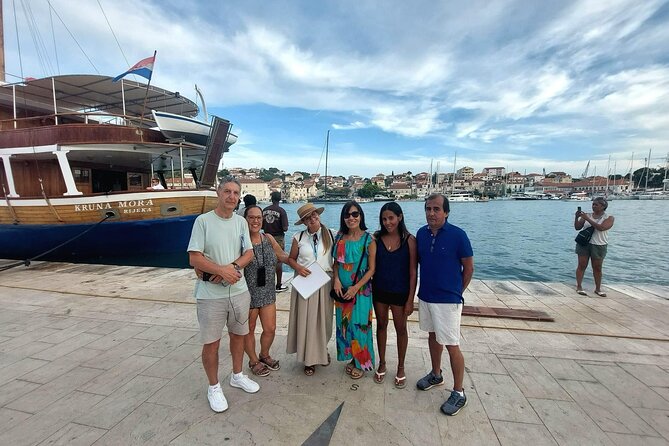
- A small group capped at 15 means you’re more likely to hear details clearly and ask questions.
- Cathedral of St. Lawrence (bell tower panorama) gives you the big-picture view over Čiovo, the mainland, and the Adriatic.
- Radovan’s Portal puts you face-to-face with a rare, early-13th-century sculptural entrance.
- Civic Trogir stops like John Paul II Square, the Town Loggia, and the Town Hall show how the town functioned.
- Riva promenade to Kamerlengo Castle is a clean finish: wide views, the water right there, and a fortress at the tip of the old town island.
Getting oriented fast in Trogir Old Town
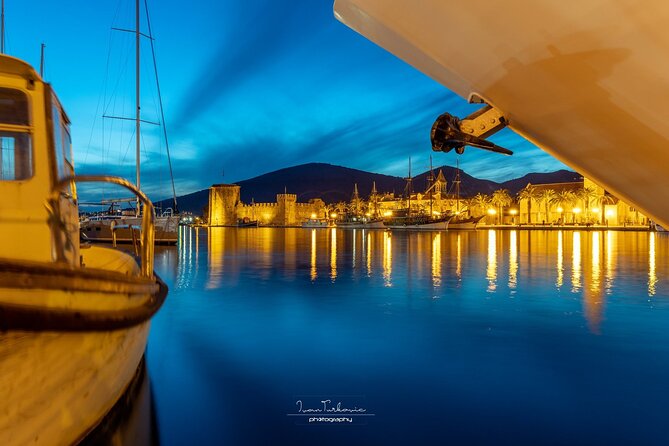
If you only have a short window in Trogir, you’ll like how this walk organizes the place. Trogir’s Old Town can feel like a maze, but this route turns the confusing lanes into a set of purposeful stops: cathedral first, then public squares, then the palaces and church sites, and finally the waterfront.
A local guide matters here. The best part isn’t the big monuments alone, it’s the way a local explains how all those buildings fit together—religion, government, trade, and daily life—so you start recognizing patterns as you wander on your own later.
You can also read our reviews of more walking tours in Trogir
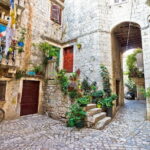
Meeting point to walking rhythm: what the route feels like
You begin at Ul. Gradska vrata 5 (21220), then you finish back out near the waterfront area at Obala bana Berislavića (21218). That end location is smart, because it naturally sets you up to keep exploring by foot without having to retrace your steps.
In terms of pace, expect about 1 hour 30 minutes. The route is built for seeing the main highlights without turning into a speed-walk, but you are on cobbles and you’re moving between stops. If you’re the type who likes to stop and look up close, give yourself a tiny buffer before dinner plans.
Cathedral of St. Lawrence: five centuries, three naves, one view
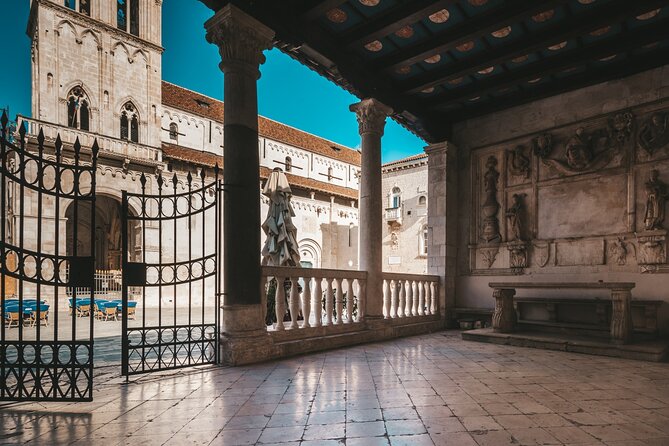
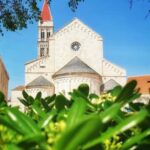
The tour’s backbone is the Cathedral of St. Lawrence. Work on the cathedral began in 1213 and continued for roughly five centuries, which explains why it carries both Romanesque and Gothic styling.
When you stand in front of it, don’t rush past the scale. The cathedral’s massive body has three naves, and that layout is one of those details that tells you how important the site was long before Trogir became a postcard destination. Even if you only spend a few minutes here, you’ll feel the weight of the place.
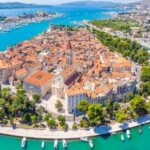
And then there’s the bell tower. This is where you earn your first real payoff: a panoramic view over Trogir, the island of Čiovo, the mainland, and the Adriatic Sea. If you’ve been squinting at rooftops and trying to imagine where the harbor sits, the bell tower view clears it all up fast.
Practical note: views are always better with slightly relaxed timing. If you’re taking photos, plan to let a minute or two go by without rushing the next photo.
Radovan’s Portal: the kind of detail you’ll miss alone

From the cathedral, you move to Radovan’s Portal, the main entrance sculpted and carved by Master Radovan from medieval Trogir. This is one of those sites where you can stare at the stone work and still not know what you’re looking at—until a local guide points out what makes it distinctive.
Radovan’s Portal dates to the first half of the 13th century, which means it sits at a turning point in European art styles. The portal is a strong example of how medieval craftsmen built identity into architecture: the entrance becomes both worship space and civic statement.
If you like sculpture, you’ll probably want extra time here. Even a short stop can turn into a longer one if you start seeing the layers—because once you understand the craftsmanship, the portal stops being just decoration.
John Paul II Square: history that feels like a café scene
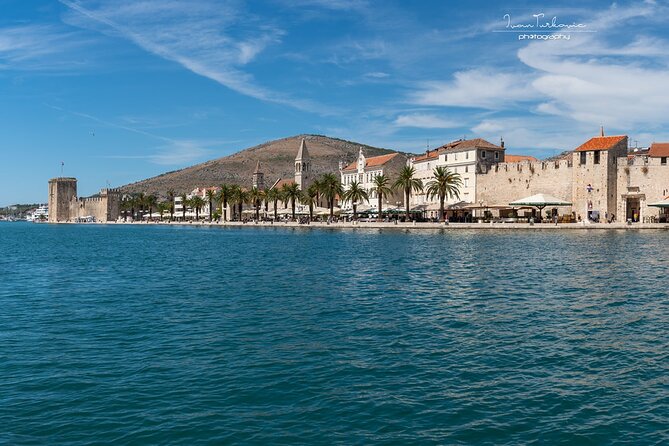
Next comes the central square, known as John Paul II Square (Trg Ivana Pavla II). This is one of the most relaxed parts of the Old Town route. The square is surrounded by important buildings, but it’s also largely claimed by cafe tables and umbrellas—so you experience history in real time, not in a museum box.
I like this stop because it resets your brain. After stone façades and religious architecture, you get a place where you can sit, look around, and connect the buildings you just saw to daily rhythms: people meet here, people linger here.
If you’re traveling solo or with a friend who loves coffee breaks, this is your moment. You can easily build your schedule around it and still feel like you’re getting something cultural.
You can also read our reviews of more guided tours in Trogir

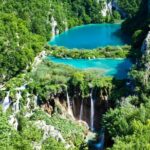
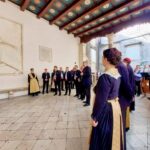

Town Hall and the Venetian staircase effect

From the square, the tour hits the Town Hall, a 15th-century stone building with an elegant courtyard decorated with coats of arms. Then there’s the outside staircase, which is one of Trogir’s most striking examples of Venetian architecture in town.
This is where you start seeing Venetian influence in a more functional way. It’s not only about style, it’s about how power and administration shaped the layout of public space. A courtyard with coats of arms isn’t just pretty; it signals who belonged, who ruled, and where official life happened.
A good guide will help you notice how the building communicates importance. Even from a distance, the stairway design gives you that Venetian rhythm—so when you walk past similar details later in Trogir, you’ll be able to spot the signature cues quicker.
St. Sebastian Church: plague gratitude and a specific architect
Next is St. Sebastian’s Church and Clock Tower, built in 1476 by Trogir’s citizens as gratitude after being delivered from the plague. That backstory changes how you read the building. It becomes a monument to survival and relief, not just an old church on a corner.
The architect is Niccolò di Giovanni Fiorentino (often referred to in English as Nicolas of Florence). Knowing the architect name gives you a thread. It helps you understand that this wasn’t random building activity, it was part of wider Renaissance-era networks of designers and ideas.
If you’re the kind of traveler who likes to connect dots, this stop is satisfying. You go from medieval scale at the cathedral to later civic gratitude here, and suddenly the town’s timeline feels less abstract.
Town Loggia: where civic decisions played out under shelter

After the church, you’ll see the Town Loggia, dating to the 13th century. It’s a covered civic space next to the Clock Tower, and it used to be a place where citizens congregated to discuss issues of the day.
The loggia also served as a meeting space for the local court on certain days for proclaiming laws and handling cases. In other words, this isn’t a decorative arcade. It’s the kind of architecture that tells you where arguments happened and where decisions were made.
This is a great stop for understanding daily governance. If you only know Trogir from photos, you’ll miss this function. With a local guide, the loggia becomes a social stage, not just a pretty hallway.
Palace Cipiko: Romanesque roots with Venetian Renaissance remodeling
The tour continues to Palace Cipiko, often described as the Great Cipiko Palace. The site is composed of Romanesque buildings, then remodeled into a Venetian Renaissance look between the 15th and 17th centuries.
One reason this stop works on a walking tour is that it shows you transformation over time. You can see how styles change while the structure remains grounded, which helps you understand Trogir as a living town rather than a freeze-frame of the past.
Niccolò di Giovanni Fiorentino appears again here, including carving the palace’s south portal. If you’ve been tracking his name from St. Sebastian, you’ll appreciate how the architecture connects rather than repeats.
North Gate and the Garagnin-Fonfogna palaces
As you pass into the Old Town through the North Gate, you’ll come across the palaces once owned by the Venetian family of Garagnin-Fonfogna. The route includes a chance to see the museum area associated with those palaces right as you enter.
Even if you don’t go inside, this moment helps you place the Old Town’s “front door” in context. A gate isn’t only defensive. It’s also where trade, status, and movement all converge.
If you’re the type who always thinks, where should I spend more time later, jot down what you’d like to revisit after the walk. This is one of those places where a short exterior look can help you decide whether a longer stop is worth it.
Church of Our Lady of Mount Carmel: fishermen, craftsmen, laborers
The tour makes a thoughtful detour to the Church of Our Lady of Mount Carmel, founded in the Middle Ages. Historically, it served as the church for Trogir’s fishermen, craftsmen, and laborers.
That’s an important contrast to the monumental cathedral focus. Here, the story shifts from top-level religious power to everyday people and working life. You’ll find the church just off the waterfront promenade in the western part of Old Town.
There’s also a timing detail to watch for: if you’re in Trogir on 16 July, the church has a traditional procession in the evening with the statue of Our Lady. Even if your visit doesn’t line up, knowing that the site still holds community meaning makes it more than a stop on a list.
Kairos bas-relief: a small artwork with big timing advice
Some stops are worth it because they change how you look at the street corners. Here, you’ll see a bas-relief with a figure standing on tiptoe, arms outstretched, holding a pair of scales. The message is tied to Kairos, the idea of the right moment.
The sculpture’s details matter: the young man is ready to fly away, with a tuft of hair and a bald crown, and the symbolism is about seizing the moment before it slips past. It’s a quick stop, but a memorable one.
I like adding at least one human-scaled art stop on a walking tour. It gives you something to carry with you, long after the big monuments fade.
Waterfront Riva promenade: palm-lined, flat, and made for views
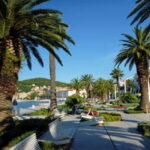
Then you shift from stone to sea at the Riva waterfront promenade. Locals call it Riva, and it’s wide, flat, and straight—so it’s easy walking even when the older streets become a little twisty.
The views are the payoff: you look across the sea channel to the island of Čiovo and you get a clean perspective on the harbor area. If the sun is up and you want to reset, this is a great place to do it.
This stretch also helps you connect earlier landmarks to where they sit relative to the water. After a guide explains the town’s geometry, you can walk the waterfront later on your own and feel like you’re navigating on purpose.
Kamerlengo Castle: early 15th-century fortress at the old town tip
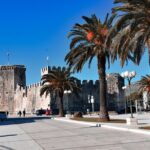
At the end of the promenade you reach Kamerlengo Castle, an early 15th-century fortress on the corner of the tiny island that hosts Old Town. It’s one of those final stops that works because you get both structure and context at once.
Right nearby, you’ll see a local football pitch, a small playground for kids, and stalls operated by local tour operators. That blend is exactly what makes the ending feel real. You’re not leaving a theme park set; you’re arriving at a working edge of the town.
If you’re tired, this is still worth it because it’s mostly visual and open, and you can linger without needing to keep climbing stairs.
Price and what $18.14 buys you in real terms
At about $18.14 per person for roughly 90 minutes, the value is in the efficiency and the human factor. The route hits major monuments without requiring you to piece together everything yourself.
The real cost savings here is time and clarity. Trogir can be stunning, but it’s easy to wander without understanding why one portal matters more than another or why a loggia was built for courts and laws. Paying for a local guide is like paying to skip the blank spots in your own map.
You’ll also benefit from practical touches: this experience uses a mobile ticket, runs in English, and is capped at 15 travelers. Small group size is one of those details that changes everything, especially around sculptural entrances and tight street corners.
Who should book this walking tour
This is a smart pick if:
- You want to see the main highlights without building a complicated plan.
- You like architecture and sculpture and want help reading Romanesque/Gothic and Venetian details.
- You enjoy guides who share personal, local context, not just a list of facts. Names like Daniela, Kristina, Blanca, Michael, and Christina show up in guide feedback, and the common thread is storytelling grounded in everyday Trogir life.
It may not be ideal if you want a slow, stand-in-place photo session for every stop. This is built for flow and orientation.
Should you book? My take on the call
I’d book this walk early in your Trogir stay if you can. It gives you the kind of orientation that makes the rest of your free wandering feel easier and more rewarding.
Choose it confidently if you’re traveling in English and you want a compact route that still hits big-ticket items like St. Lawrence’s Cathedral, Radovan’s Portal, civic spaces like Town Loggia, and the waterfront ending near Kamerlengo Castle. With an overall 5-star average and a near-universal recommendation rate, this is the sort of experience that tends to work for different ages and travel styles.
Pick a different plan only if you’re not into walking Old Town streets at a steady pace, or if your schedule is too tight to handle about 90 minutes outdoors. If the weather turns, you may need a date swap or refund option, since the tour depends on good conditions.
FAQ
How long is the Trogir walking tour with a local guide?
It runs for about 1 hour 30 minutes.
What language is the tour offered in?
The tour is offered in English.
Is a mobile ticket provided?
Yes, the tour uses a mobile ticket.
What is the starting and ending point?
Start: Ul. Gradska vrata 5, 21220, Trogir, Croatia. End: Obala bana Berislavića, 21218, Trogir, Croatia.
How large is the group?
The maximum group size is 15 travelers.
What are the main sights you’ll see?
You’ll visit highlights including the Cathedral of St. Lawrence and Radovan’s Portal, John Paul II Square, Town Hall, St. Sebastian’s Church and Clock Tower, Town Loggia, Palace Cipiko, the North Gate area connected to the Garagnin-Fonfogna palaces, Church of Our Lady of Mount Carmel, the Kairos bas-relief, the Riva waterfront promenade, and Kamerlengo Castle.
Are there any stops with admission ticket requirements?
The stops are listed with admission ticket free for multiple key highlights.
Is the tour outdoors?
Yes, it’s a walking tour and requires good weather.
When will I get confirmation?
Confirmation is received at the time of booking.
What is the cancellation and refund policy?
It is non-refundable and cannot be changed for any reason. If the experience is canceled due to poor weather, you’ll be offered a different date or a full refund.