REVIEW · SPLIT
Private History and Trivia Walking Tour by a Local Guide
Book on Viator →Operated by Lingua Tours · Bookable on Viator
Split makes sense in under two hours. This private, local-guided history and trivia walk is a fast way to learn how Diocletian’s Palace reshaped everyday life, and it also gives you practical city tips and local customs you can use right away. I especially love the chance to hear the stories behind major landmarks like Diocletian’s Palace (from the Bronze Gate to the Golden Gate) while staying on walkable streets buses miss. One watch-out: the pace is intentionally quick, so if you prefer long museum stops or slow wandering, you may feel a bit rushed.
What makes it work is the format: a private group tour that still keeps a small headcount (up to 15), guided in English, French, German, Spanish, or Italian. You’ll follow a set route with stops at key sites, then finish right back where you started on the harbor promenade—nice if you’re squeezing this into a tight day.
In This Review
- Quick hits before you go
- Why this private Split history walk is great for tight schedules
- Riva Harbor: start with the palace walls and the Split waterfront
- Bronze Gate substructures: getting under the palace story
- The Peristyle Square: the palace’s central stage
- Cathedral of Saint Domnius: when a mausoleum becomes a cathedral
- Temple of Jupiter: from ancient temple to baptistery
- Fruit’s Square and the narrow street: local color in a tiny space
- Narodni trg and Piazza squares: what makes the main squares feel important
- Zeljezna Vrata, eastern palace gates, and the iron-gate history
- Golden Gate and Ivan Meštrović’s bishop statue
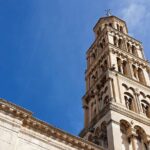
- Bell Tower of St. Arnir: early Christian remnants beside a view-maker
- Marmontova Ulica finish: the long hill view over theater and monastery
- Price and value: does $53.95 make sense?
- What you’ll actually get from the guide’s trivia and question time
- Practical pacing: what to do before and after
- Who this tour is best for
- Should you book this private history and trivia walking tour?
- FAQ
- How long is the Split private history and trivia walking tour?
- Is this tour truly private?
- How many people are in a group?
- Where do we meet, and where does the tour end?
- What languages are the guides available in?
- Are there any admission tickets included for the stops?
- What’s included in the price?
- Can I cancel for a full refund?
- What kind of visitors does this tour work for?
Quick hits before you go
- Private, small-group feel: up to 15 people, and only your group participates
- Triaged to the best stops: Roman palace highlights, cathedral area, and major city squares in 1h45
- Walking gets you closer: narrow street sections and palace entrances you don’t see from a bus window
- City tips along the way: customs and practical guidance built into the history talk
- Guides in multiple languages: English, French, German, Spanish, Italian
Why this private Split history walk is great for tight schedules
This is the kind of tour I like when I only have a small slice of time and I want my bearings fast. The route is built around the core storytelling locations in Split: start at the waterfront, move into Diocletian’s Palace spaces, then work outward through squares and gates until you’re looking down a famous hill street at the end.
Two things really drive the value:
- You’re not just seeing famous names. You’re getting explanations that connect what you’re looking at to how the city changed over time.
- You get a human filter on the chaos. A local guide can point out what matters, what to skip later, and how to read the city without turning it into a checklist.
The main drawback is the same thing that makes it efficient: it’s a whistle-stop walk. Even though each stop is relatively short, you’ll likely want to return to your favorite corners afterward for photos, a second look, or a longer rest.
You can also read our reviews of more walking tours in Split


Riva Harbor: start with the palace walls and the Split waterfront
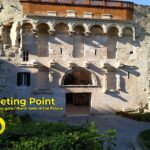
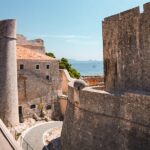
You meet at Obala Hrvatskog narodnog preporoda 22 on the harbor promenade. From the start, the guide frames the area so you can understand how Split’s harbor and the palace layout relate. You’ll see the southern wall of Diocletian’s Palace along with the harbor itself, plus views along the eastern and western promenade/coast.
This first stop is smart because it anchors everything you’ll see later. Instead of marching into the palace blind, you begin with context: where the water is, where the palace mass sits, and how the city’s shape comes from that.
Bronze Gate substructures: getting under the palace story
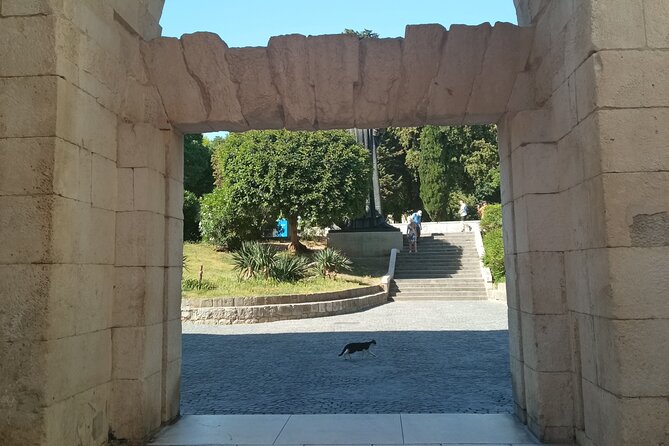
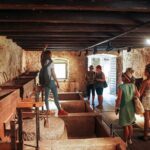
Next you enter the Diocletian Palace substructures through the southern entrance, the Bronze Gate. This is one of those moments where your guide’s role really matters. The substructures add a different feel than the open-air palace squares; you start understanding how the complex worked as part of a larger system, not just as a dramatic backdrop.
Even if you only catch a small portion of the space, it’s a useful contrast. You’re essentially learning to read the building like a timeline, from the original Roman function to the later layers of meaning that visitors usually only hear about at a high level.
The Peristyle Square: the palace’s central stage
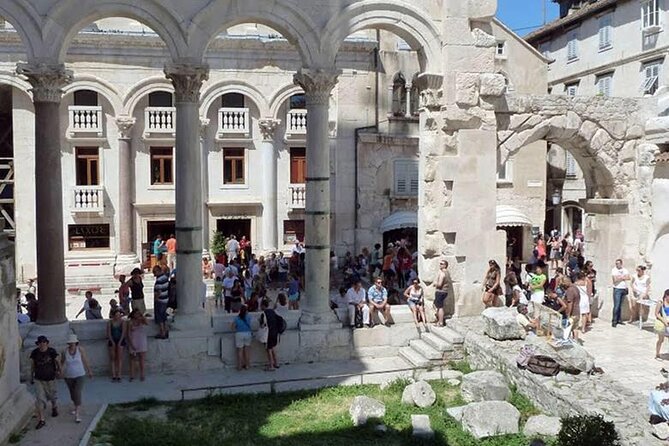
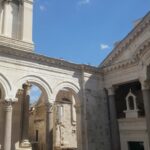
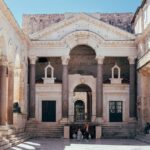
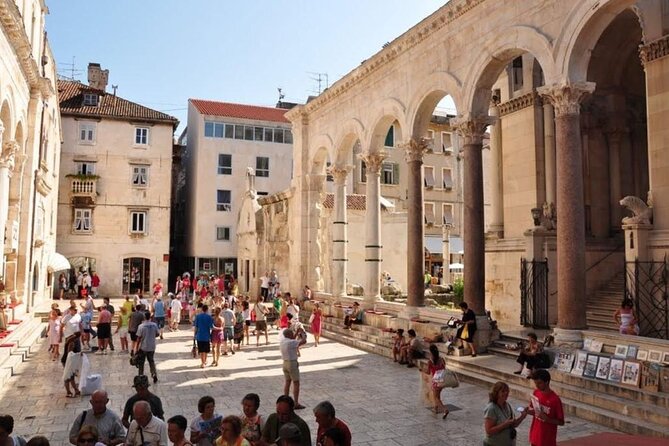
From the substructures, the tour pauses at the Peristyle, the palace’s central ancient square. This is where the guide slows down just enough to give you cultural and historical background for the setting.
What I like here: the Peristyle is visually clear, but it’s easy to miss the significance if you treat it like just another big open space. With a guide, it becomes a key turning point in the narrative—what this place was meant to be, and why that matters for understanding the rest of the palace area.
Cathedral of Saint Domnius: when a mausoleum becomes a cathedral
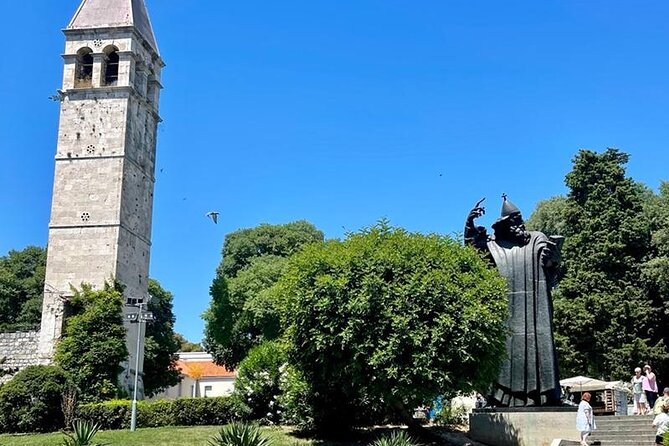
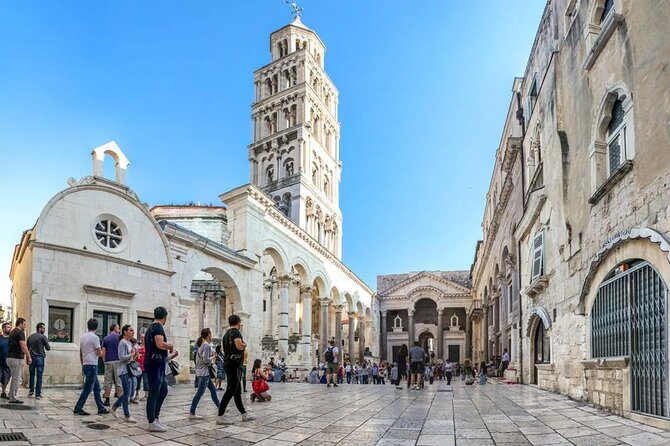
Right after the Peristyle, you’ll visit the Cathedral of Saint Domnius. The guide explains the role the Mausoleum of Emperor Diocletian played, and how it was turned into a cathedral. You’ll also hear about construction style connections between the cathedral and the adjacent bell tower area.
This stop is valuable because it shows you how reuse happens in real cities. You’re not just looking at separate buildings; you’re seeing the same site evolve across time, and the guide ties that evolution to what you can still observe today.
You can also read our reviews of more guided tours in Split





Temple of Jupiter: from ancient temple to baptistery
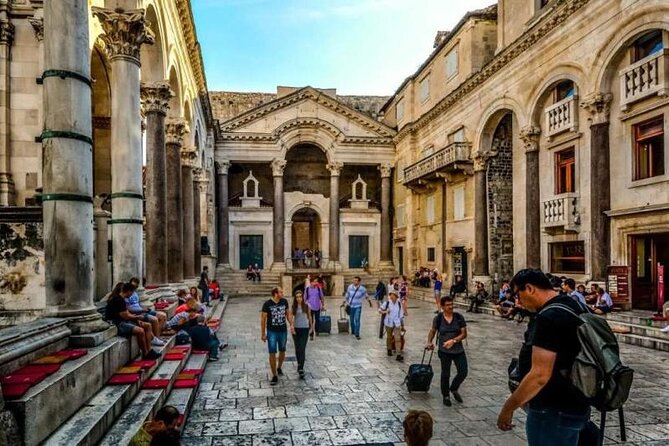
Next comes the Temple of Jupiter. The explanation here focuses on transformation: the guide explains how the temple was turned into a baptistery as Christianity spread within the palace walls. There’s also a sphinx in front, and the guide uses it as a stark reminder of how layered the palace complex can be.
If you like stories that connect art, religion, and stonework, this is a strong stop. It also helps your brain keep the sites straight later, because you’ll remember not just the names but the pattern of change.
Fruit’s Square and the narrow street: local color in a tiny space
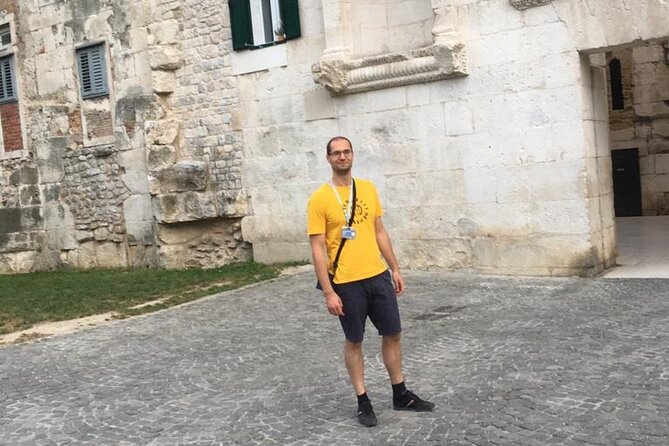
A short hop brings you to Fruit’s Square (Trg Brace Radic), accessed via the narrowest street section in Split connected to the Pusti me Proć area. This is one of the tours’ best “feel the city” moments because it changes your pace and your sense of scale.
Here the guide talks about the town of Split and its development—or the lack of it at the time when Split was under certain conditions. Even without sitting still long, you get the kind of detail that makes the city feel less like a photo spot and more like a living place with quirks.
You’ll also pass by a statue of Marko Marulić, described as the father of Croatian literature, and you’ll see the Milesi family palace from the 17th century just behind him.
Narodni trg and Piazza squares: what makes the main squares feel important
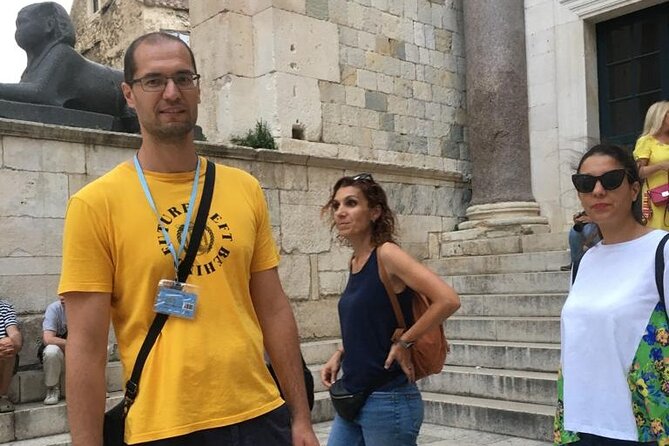
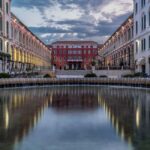
The tour continues to Narodni trg, the main square area—then works through what the guide frames as the historical development of how it became the town’s main square. You’ll also pass multiple palaces belonging to wealthy families over different periods, including a recently renovated palace connected to a noble family, plus an old City Hall and palaces on both ends of the square.
A small note on why this section matters: squares can look identical in your first hour of sightseeing, but guides who know the local layout can help you understand which ones were designed for power, which were practical for daily life, and how that shows up in the streets around them. This part helps you connect the dots across the route.
Zeljezna Vrata, eastern palace gates, and the iron-gate history
As you go eastward, you reach Zeljezna Vrata, the western gate of the palace area. This is where the guide leans into the gate’s “rich history” and its role in past activities. You’ll hear about the structure’s age and significance in a way that makes gates feel less like decoration and more like control points.
Along the way, you’ll also pass palaces tied to wealthy families, including a 17th-century palace from the Cindro family and a 15th-century palace belonging to an Italian family (named Augubio in the tour description).
Golden Gate and Ivan Meštrović’s bishop statue
Next, you’ll visit the Golden Gate, described as the northern entrance and the most decorated. The guide explains why its construction matters and what it demonstrates about Roman building expertise.
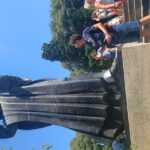
Then, opposite the northern gate, you’ll see the statue of Bishop Grgur of Nin by Croatian sculptor Ivan Meštrović. The guide explains why Bishop Grgur represents an important impact in Croatian history and identity, giving you a reason to see the statue as more than an impressive landmark.
Bell Tower of St. Arnir: early Christian remnants beside a view-maker
Just next to the Grgur of Nin statue area, the tour moves to the Bell Tower of St. Arnir, including the chapel of Saint Arnir and the remnants of an early Christian church. The guide gives a short explanation about what you’re seeing here.
This stop is efficient, but it’s also a “thread” moment: the tour isn’t only dropping big names. It’s connecting religious and architectural layers so you understand that Split’s center isn’t frozen in time—it keeps changing roles.
Marmontova Ulica finish: the long hill view over theater and monastery
The tour ends at the top of Marmontova Ulica, overlooking the Croatian National Theater and the Monastery and Church of Our Lady of Health. You also get a quick historical explanation related to the area below, described as connected to a short-lived aspect—enough to help you read the skyline as part of the city story.
Finishing up top is a smart way to land the tour. Your brain gets a “wide view” moment after a series of close-up palace details. It’s also a good reset if you’re about to continue your day with your own plans.
Price and value: does $53.95 make sense?
At $53.95 per person for about 1 hour 45 minutes, this is not a bargain walk—but it’s also not priced like a luxury experience. In this area, you’re paying for two practical things:
- A private guide format that still keeps the group small (maximum 15)
- A curated route that focuses on high-impact stops without time wasted searching for the right entrance or trying to connect sites yourself
Also, the stops are effectively “no-extra-admission” in the tour description, since the key sights listed are marked as admission ticket free. That helps you feel like you’re getting more sightseeing per dollar, because you’re not layering multiple entry fees onto an already short tour.
If you’re traveling solo or as a couple, private-guided time in a historic core can be worth it because you don’t lose half your day to orientation. If you’re with a larger group, the tour notes group discounts, which can improve the per-person value.
What you’ll actually get from the guide’s trivia and question time
One theme that matters is how the guide handles questions. The feedback tied to this tour repeatedly highlights guides who are friendly and fun, and who answer questions with real depth instead of a quick one-liner. That matters because Split’s history can feel like overlapping eras of the same stone surfaces. A good explanation helps you build a mental map.
You also get a trivia layer, not just lectures. That shows up in the way the guide frames things like the sphinx, the narrow street, the literary figure Marko Marulić, and the different palace owners around the squares. You leave with details you can repeat later, which is the fastest way to make history stick.
Practical pacing: what to do before and after
This walk is tight by design, so set yourself up for success:
- Start with comfortable walking shoes. The route includes palace steps, narrow street sections, and a hill climb/finish at Marmontova Ulica.
- Bring the right energy for a sprint. You’ll get more out of it if you’re ready to ask questions and keep moving.
- Plan to follow your guide’s hints afterward. Even a short tour like this works best when you use it as a springboard for the rest of your day.
If you’re the type who likes to sit and absorb one church or one view for a long time, you might feel pressure here. The workaround is simple: pick your favorite stop and revisit it later under your own pace.
Who this tour is best for
This is a strong fit if you:
- Want an efficient introduction to Split’s center and Diocletian’s Palace
- Appreciate history tied to specific places rather than generic overviews
- Like learning local customs and practical city tips while sightseeing
- Prefer a smaller private group setting over large bus crowds
It may be less ideal if you:
- Only want slow, unhurried time at major sites
- Dislike walking tours that move between many stops
- Want a tour that focuses on museum-style interior time rather than outdoor landmark interpretation
Should you book this private history and trivia walking tour?
I’d book it if you’re visiting Split for a short trip or you want your first day to feel organized. For the price, you’re buying more than a route: you’re buying a local storyteller who can connect the palace, cathedral area, and main squares into one coherent walk.
Choose it when you want to:
- Get your bearings fast
- See Diocletian’s Palace highlights you can’t easily capture from a bus
- Leave with concrete knowledge you can use while exploring on your own
If you know you’ll be easily overwhelmed by a quick pace, then plan a follow-up day for slower wandering. But for most time-tight visitors, this is a smart, high-return way to understand Split’s core.
FAQ
How long is the Split private history and trivia walking tour?
It’s about 1 hour 45 minutes.
Is this tour truly private?
Yes. It’s listed as private, and only your group participates.
How many people are in a group?
The maximum group size is 15 persons.
Where do we meet, and where does the tour end?
You meet at Obala Hrvatskog narodnog preporoda 22, 21000, Split. The tour ends back at the meeting point.
What languages are the guides available in?
Guides are available in English, French, German, Spanish, and Italian.
Are there any admission tickets included for the stops?
The stops listed are marked as admission ticket free in the tour schedule, and the tour does not list separate paid admissions for these key sights.
What’s included in the price?
A local licensed guide speaking your selected language is included. Personal expenses are not included.
Can I cancel for a full refund?
Yes, you can cancel up to 24 hours in advance for a full refund.
What kind of visitors does this tour work for?
It’s described as suitable for most travelers, and the feedback attached to the experience includes families with children enjoying the tour too.