REVIEW · SPLIT
Chill Private Walking Tour of Diocletian’s Palace
Book on Viator →Bookable on Viator
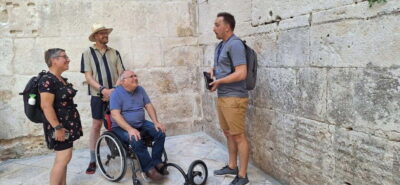
Roman walls make more sense with a guide. This private 1.5–2 hour walk in Split’s Diocletian’s Palace is packed with clear explanations and 3D reconstructions that show what you’re seeing in its original Roman form. With guide Mili, you also get the story’s twists—how a Roman palace became a lived-in, religion-layered neighborhood over the centuries.
I love the pacing. You don’t feel rushed, and the guide keeps the walk moving block by block through the palace’s key spaces. I also like the balance: you get the big historical ideas, then you learn where to look so the stone details start clicking. One thing to consider is that the tour includes mostly free exterior areas, while the optional interior tickets (like the cathedral and parts of the substructures) can add time and extra cost if you choose to go in.
In This Review
- Key highlights you’ll actually notice on the walk
- Why Diocletian’s Palace feels different with a real guide
- Price and group size: what $107.84 really means
- Meeting at the Eastern (Silver) Gate, then walking the palace in order
- Stop 1: The Peristyle of Diocletian’s Palace (and where the story begins)
- Stop 2: Diocletian Palace substructures (free sections first, museum if you choose)
- Stop 3: Cathedral of Saint Domnius (Roman tomb to Christian cathedral)
- Stop 4: Temple of Jupiter (repurposed, still standing)
- Stop 5: Triklinij (a partial reconstruction of how Diocletian lived)
- Stop 6: Papalićeva ulica (the palace spills into the city)
- Stop 7: Fruit’s Square (Trg Brace Radic) and the Croatian layers
- Stop 8: The Golden Gate (fortifications, then and now)
- Stop 9: Grgur Ninski statue (wrapping the story outside)
- The weather, time, and comfort reality check
- Who this tour is best for
- Should you book this private Diocletian’s Palace tour?
- FAQ
- FAQ
- How long is the Chill Private Walking Tour of Diocletian’s Palace?
- Where does the tour start and where does it end?
- Is the tour private?
- Is the tour offered in English?
- Do I need tickets for the interiors?
- What if I want to add the cathedral or substructures museum?
- What is included in the tour?
- What happens if the weather is bad?
Key highlights you’ll actually notice on the walk
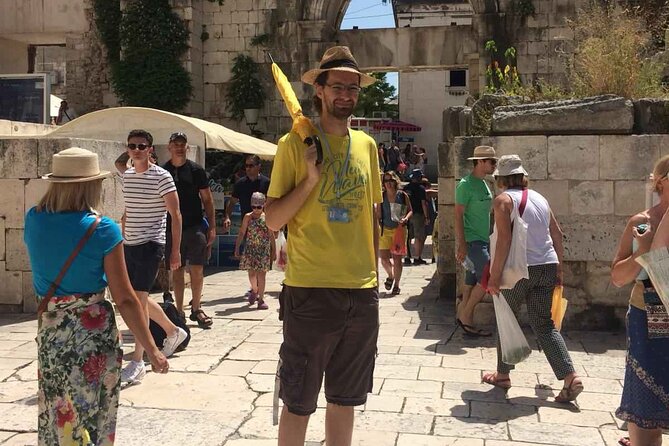
- A private format (your group only), so you can ask questions without waiting for a crowd
- Stop-by-stop storytelling that connects Roman design to later Christian reuse
- 3D reconstructions that help you picture what’s missing or destroyed
- Real-world details tied to how Split developed around the palace walls
- Flexibility in bad weather when storms hit, including route adjustments (at least in past tours)
- Game of Thrones pointers for fans who want fun context alongside the history
Why Diocletian’s Palace feels different with a real guide
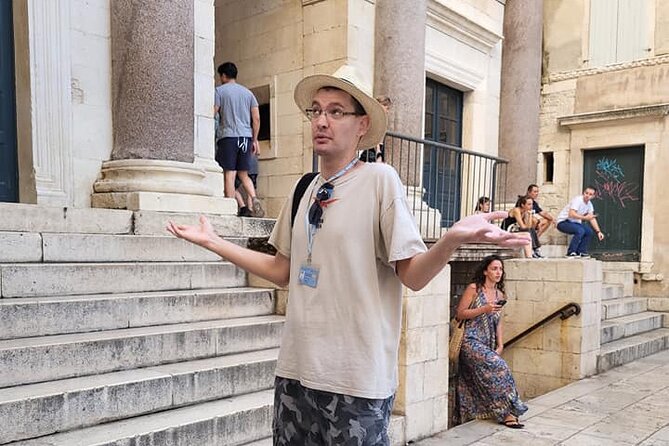
Diocletian’s Palace can look like a jumble at first. You see gates, archways, and stone corridors, but it’s hard to tell what used to be ceremonial space, what was practical living space, and what got rebuilt later. The best part of this tour is that it turns those spaces into an easy story you can follow while you walk.
I especially like how the guide ties the palace’s layout to what you’re standing on. You’re not just collecting facts—you’re learning how a fortified Roman complex worked, then how those same spaces got repurposed and absorbed into everyday life in later centuries. If you’ve ever wished that “Roman ruins” came with a map you could feel, this tour is the fix.
And because it’s private, you get the small wins too. When something catches your eye, you can usually ask, and the guide can point it out from the right angle instead of doing a one-size-fits-all explanation.
You can also read our reviews of more walking tours in Split



Price and group size: what $107.84 really means
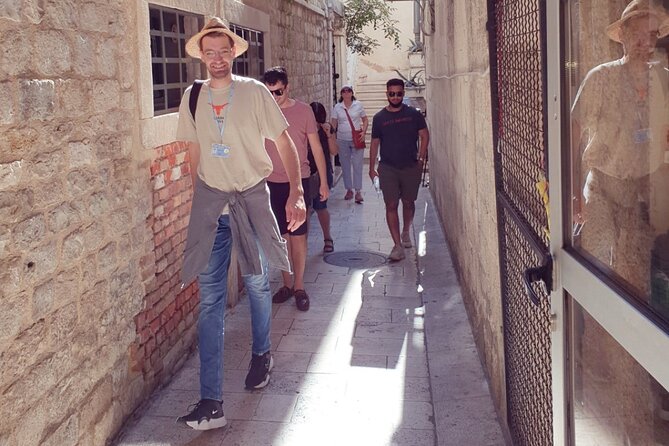
The price is $107.84 per group for up to 15 people. On paper, that means it’s often best value if you’re a small group or family traveling together, not if you’re one solo traveler hunting for the cheapest option.
For a site like Diocletian’s Palace—where the “why” matters as much as the “what”—a guided private format can be a smart trade. You’re paying for a guide’s ability to connect architecture, religion, and the city’s growth without you needing to stop and read your way through everything yourself.
Duration is about 1 hour 30 minutes to 2 hours, so you’re also buying a focused chunk of time. If you want a quick but meaningful orientation, this fits well. If you want lots of interior wandering on your own, you’ll likely need extra time beyond this tour.
Meeting at the Eastern (Silver) Gate, then walking the palace in order
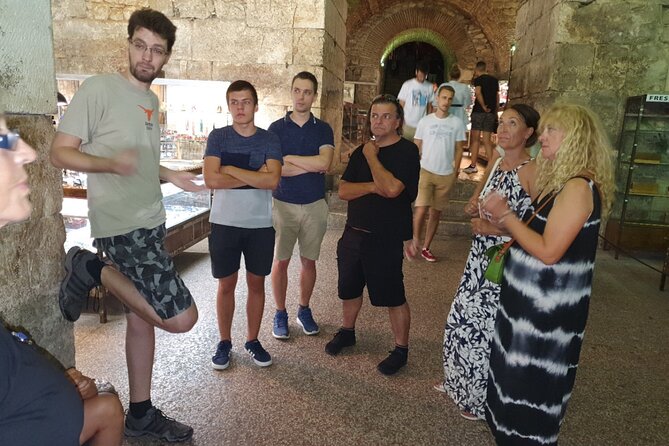
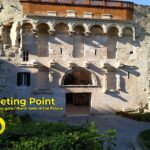
The tour starts at the Eastern (Silver) Gate, on Poljana kraljice Jelene 5. It ends at the Golden Gate area, outside the northern gate of the palace, near the bronze statue of Grgur Ninski.
This route works because it naturally follows the palace’s physical structure: you enter from one side, move through the most important rooms and landmarks, then finish near a major gate where the story can “click” into place. You’ll also get a good sense of how the palace walls shape the streets around it—because the tour continues right into streets and squares that sit next to the Roman fabric.
The meeting points are in central Split, so it should be easy to connect with other plans after the walk. It’s also designed for real movement—this isn’t a sit-down history lecture.
Stop 1: The Peristyle of Diocletian’s Palace (and where the story begins)
You start at the Peristyle, the core ceremonial space. The guide will explain who Diocletian was and how this palace came to exist in the first place. This opening matters because you’re learning the “purpose” of the palace before you start noticing details like corridors, gates, and building edges.
Plan on about 20 minutes here. You’ll want to pause and look outward as the guide talks, because Peristyle architecture is meant to feel intentional—like a central stage. Even if you’ve seen photos before, being there in person is different, especially once you understand what the space was built to do.
Possible drawback: because this is your first stop, it can feel like it’s information-heavy if you’re tired from travel. If you can, treat this like the warm-up—then the rest of the tour will start feeling more visual and less abstract.
Stop 2: Diocletian Palace substructures (free sections first, museum if you choose)
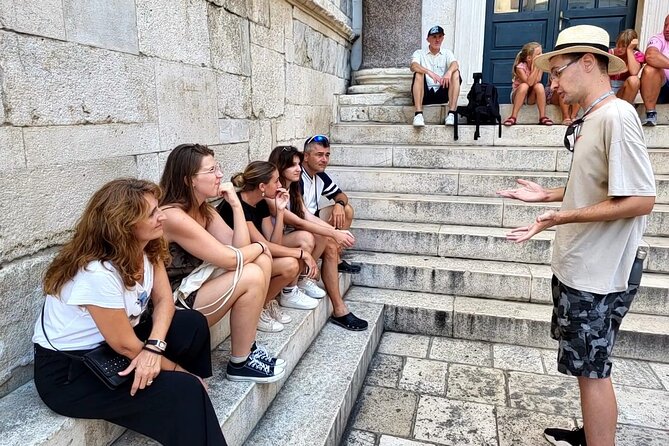
Next you move to the substructures. You’ll cover the free parts first, focused on architecture and history—how these levels supported the palace above and how the site’s design reveals Roman engineering thinking.
This stop is about 10 minutes, with an important choice. If you want more, you can buy tickets for the museum portion of the substructures, and that adds roughly 20 minutes.
This is where you can tailor the tour to your style. If you love spatial history and want to see more of the “understanding layers,” the museum add-on is a good move. If you prefer a lighter walking pace and want to keep the tour within the baseline time, you can skip it and still get the core story.
You can also read our reviews of more private tours in Split






Stop 3: Cathedral of Saint Domnius (Roman tomb to Christian cathedral)
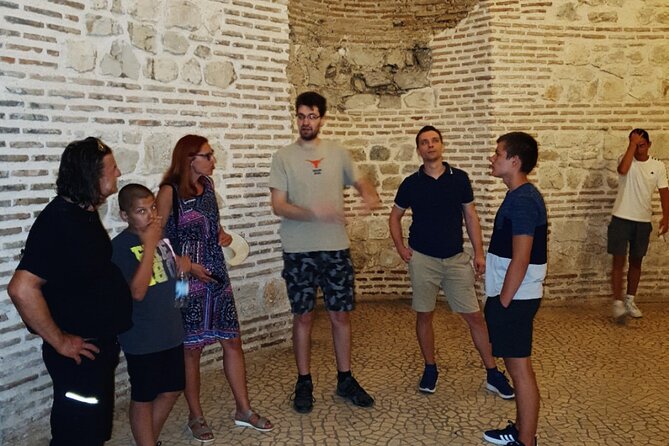
One of the best-preserved Roman structures is the Cathedral of Saint Domnius, built as part of Diocletian’s Palace. The guide explains its history and then—here’s the key idea you’ll carry through the rest of the tour—how a Roman tomb was converted into a Christian cathedral.
You’ll spend about 10 minutes here, and the tour stays flexible based on whether you have a cathedral ticket. If you do, you’ll go inside and add about 10 more minutes.
Why this stop matters: it shows you the palace’s true long life. Buildings like this didn’t just get abandoned—they got re-used. That makes the palace feel less like a frozen museum and more like a living set of spaces that kept changing its job description.
Stop 4: Temple of Jupiter (repurposed, still standing)
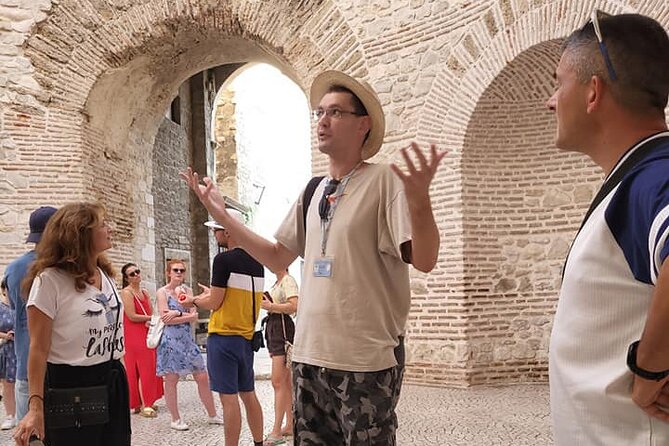
From there you head to the Temple of Jupiter, another famously preserved Roman structure. The tour focuses on how it still remains in good condition and how the church repurposed it after Roman times.
Again, the format is flexible. You’ll learn the important info outside in about 10 minutes, and if you have a ticket you can also see the small interior.
This stop is a strong contrast to the cathedral. You’ll see how different religious uses took different forms—one becoming a cathedral space, the other keeping a temple identity while being adapted. Even if you’re not a religion-history person, the physical cues make it easier to understand what changed.
Stop 5: Triklinij (a partial reconstruction of how Diocletian lived)
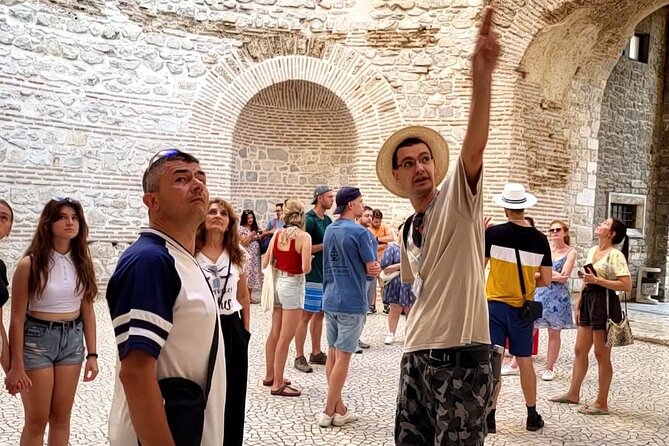
Then comes the Triklinij, in the south eastern corner where much of the palace has been destroyed. What you get instead is a partial reconstruction, built in a way that gives you an impression of how Diocletian might have lived there.
This is about 15 minutes. It’s also a great stop for visual thinkers. The idea isn’t to pretend everything is intact. It’s to show how historians and architects reconstruct what used to exist so you can make sense of what survives.
You may find this stop especially satisfying if you’ve looked at ruins before and felt annoyed by the missing pieces. Here, the missing parts are explained, not ignored.
Stop 6: Papalićeva ulica (the palace spills into the city)
Next you walk through Papalićeva ulica, an alleyway in the north half of the palace area. The guide shares interesting facts as you head along, helping you understand what you’re seeing in context rather than as a random street.
This stop takes about 15 minutes. It’s a useful breather too: after monumental spaces, you get smaller-scale details—how people moved through and around the palace in later centuries.
If you like city textures and not just big landmarks, this is the kind of stop that keeps the tour feeling grounded.
Stop 7: Fruit’s Square (Trg Brace Radic) and the Croatian layers
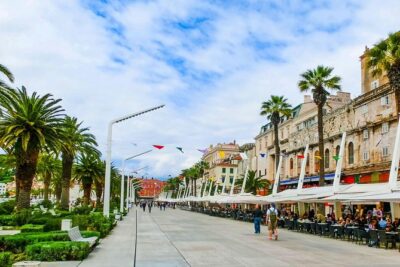
Outside the palace you reach Fruit’s Square (Trg Brace Radic). This stop is about Croatian history and how the palace has been integrated into newer buildings while still remaining visible and in use.
You’ll spend around 15 minutes here. The payoff is seeing the palace as part of the current city, not sealed off behind barriers. You’ll also get a better sense of how “old walls” become “street life.”
This is also where a guide’s local knowledge helps. You’ll learn what to notice so the square doesn’t just look like another public space—it becomes a chapter in the palace’s continuing story.
Stop 8: The Golden Gate (fortifications, then and now)
Near the end, you see the northern gate of the palace, the Golden Gate. The focus here is on fortifications and how they changed between the original construction and today’s version.
This stop is about 10 minutes, but it’s a turning point. The tour is moving from internal spaces (where daily and ceremonial life happened) toward the boundaries (where defense and control mattered).
If you enjoy architecture, pay attention to the gate’s role in the bigger layout. The guide’s explanations help you connect this gate to earlier stops, so it doesn’t feel like just another pretty entrance.
Stop 9: Grgur Ninski statue (wrapping the story outside)
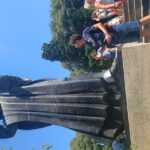
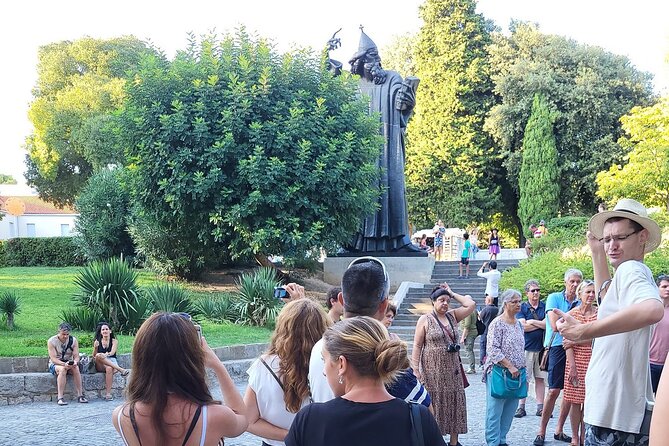
The final stop is outside the northern gate, near the bronze statue of bishop Grgur Ninski. The tour consolidates what you learned about Roman construction and then expands into Croatian history so far.
This part takes about 15 minutes. Ending here works because it gives you a satisfying “full circle” feeling: you started with Diocletian and finished with the story’s later Croatian thread.
Also, ending outside means you can keep exploring right away—no need to chase a bus or find a separate exit. You just walk on.
The weather, time, and comfort reality check
This experience requires good weather. If conditions are poor, you’ll be offered a different date or a full refund. That matters because a walking tour around ancient stone streets is hard to enjoy in cold rain.
Duration is 1 hour 30 minutes to 2 hours, but the optional interiors can stretch it. If you add the cathedral interior (about 10 more minutes) and the museum portion of the substructures (around 20 more minutes), you should plan for a longer total walk than the baseline.
My practical advice: wear comfortable shoes. Stone surfaces and historic streets can be uneven, and even if the route is well-paced, you’ll still be on your feet for most of the tour.
Who this tour is best for
This private walking tour suits you if you want:
- A guided orientation to Diocletian’s Palace without getting lost
- Clear explanations of Roman architecture and later Christian reuse
- A flexible experience where interiors are optional, not mandatory
- A calm pace for families, couples, or small groups who like to ask questions
It’s also a good match for Game of Thrones fans. The guide can share fun show-related context, but it doesn’t replace the core history.
If you’re the type who only wants photo stops and minimal talking, you might find the story portions more than you need. But if you want to understand what you’re looking at, the guided format is the point.
Should you book this private Diocletian’s Palace tour?
If you’re in Split for even a short time, I think this is an easy yes. For the price, you’re getting a private guide for up to 15 people, a smart stop sequence through the palace’s most meaningful spaces, and a way to picture what’s missing thanks to 3D reconstructions.
Book it if you want the palace to make sense as you walk—Peristyle to substructures to cathedral to Jupiter to the streets outside. Skip or downshift the optionals if you’d rather keep things light and stay close to the 1.5–2 hour window.
FAQ
FAQ
How long is the Chill Private Walking Tour of Diocletian’s Palace?
It runs about 1 hour 30 minutes to 2 hours, depending on whether you add optional interior visits.
Where does the tour start and where does it end?
It starts at the Eastern (Silver) Gate at Poljana kraljice Jelene 5, Split, and ends outside the northern gate near the Golden Gate by the bronze statue of Grgur Ninski.
Is the tour private?
Yes. It’s a private tour/activity, and only your group participates.
Is the tour offered in English?
The tour is offered in English.
Do I need tickets for the interiors?
Some interiors require optional tickets. You can still see and learn the key parts outside without paying for those interiors, and the guide can advise based on what you want to see.
What if I want to add the cathedral or substructures museum?
If you have the cathedral ticket, you can go inside and add about 10 minutes. If you buy tickets for the museum part of the substructures, it adds about 20 minutes.
What is included in the tour?
You get an experienced guide and comparisons using 3D reconstructions of how key spaces looked about 17 centuries ago. A mobile ticket is also included.
What happens if the weather is bad?
This experience requires good weather. If it’s canceled due to poor weather, you’ll be offered a different date or a full refund.